
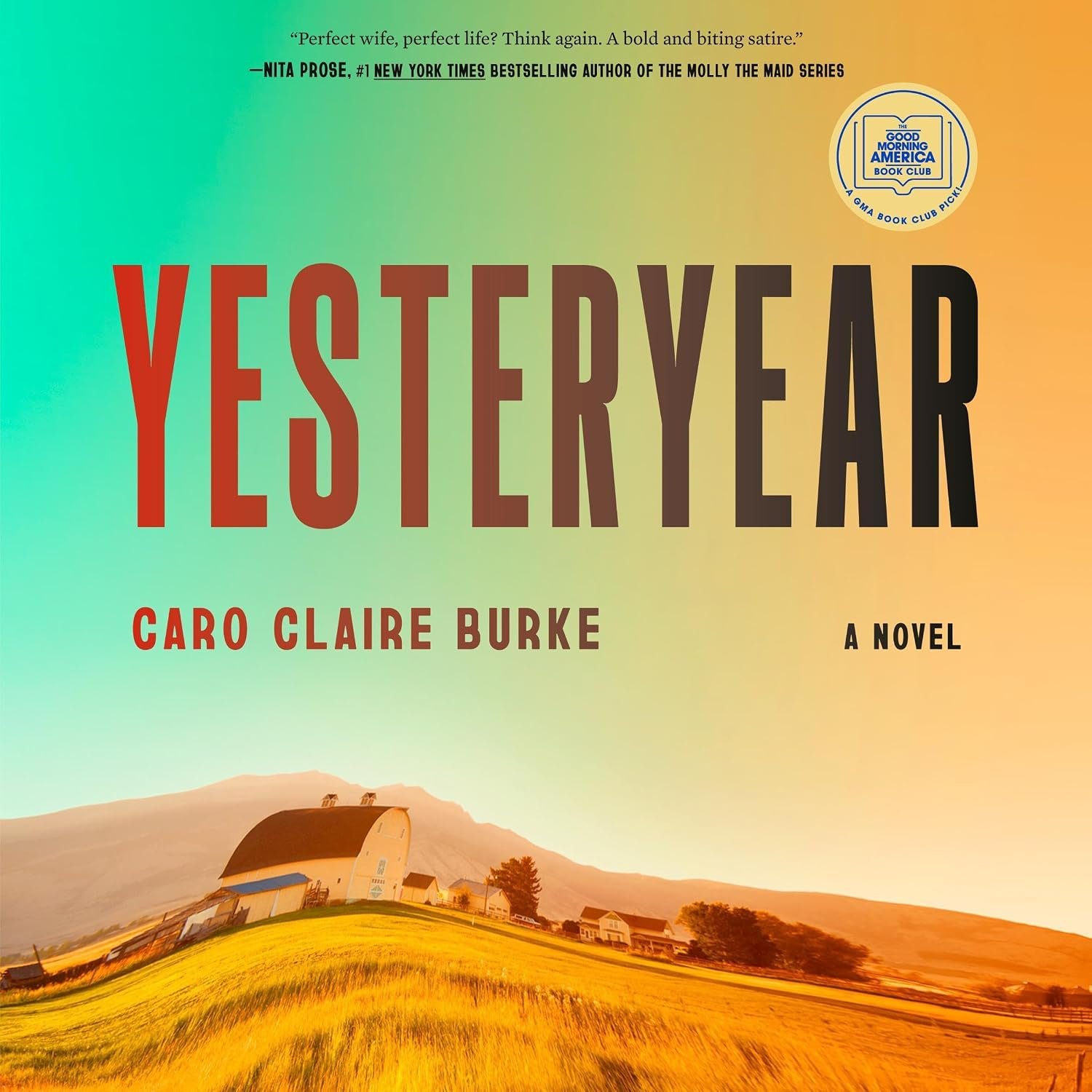
#1 NEW YORK TIMES BESTSELLER A GMA BOOK CLUB PICK A NEW YORK TIMES BEST BOOK OF THE YEAR (SO FAR) A traditional American woman, a “tradwife” influencer, suddenly awakens in the brutal reality of 1855—where she must unravel whether this living nightmare is an elaborate hoax, a twisted reality show, or something far more sinister in this sensational debut novel.
“A bold and biting satire, Yesteryear…will have you cackling and gasping right to the final page.”
—Nita Prose, #1 New York Times bestselling author of The Maid series
My name was Natalie Heller Mills, and I was perfect at being alive.
Natalie lives a traditional lifestyle. Her charming farmhouse is rustic, her husband a handsome cowboy, her six children each more delightful than the last. So what if there are nannies and producers behind the scenes, her kitchen hiding industrial-grade fridges and ovens, her husband the heir to a political dynasty? What Natalie’s followers—all 8 million of them—don’t know won’t hurt them. And The Angry Women? The privileged, Ivy League, coastal elite haters who call her an antifeminist iconoclast? They’re sick with jealousy. Because Natalie isn’t simply living the good life, she’s living the ideal—and just so happens to be building an empire from it.
Until one morning she wakes up in a life that isn’t hers. Her home, her husband, her children—they’re all familiar, but something’s off. Her kitchen is warmed by a sputtering fire rather than electricity, her children are dirty and strange, and her soft-handed husband is suddenly a competent farmer. Just yesterday Natalie was curating photos of homemade jam for her Instagram, and now she’s expected to haul firewood and handwash clothes until her fingers bleed. Has she become the unwitting star of a ruthless reality show? Could it really be time travel? Is she being tested by God? By Satan? When Natalie suffers a brutal injury in the woods, she realizes two things: This is not her beautiful life, and she must escape by any means possible.
A gripping, electrifying novel that is as darkly funny as it is frightening, Yesteryear is a gimlet-eyed look at tradition, fame, faith, and the grand performance of womanhood.
View on Amazon
Yesteryear: A Darkly Funny and Unsettling Novel About Tradition, Fame, and Womanhood
Yesteryear is a gripping and provocative debut novel that takes a familiar image of the perfect traditional lifestyle and turns it into something deeply unsettling. At the center of the story is Natalie Heller Mills, a successful “tradwife” influencer whose carefully constructed public life appears almost impossibly perfect. With millions of followers, a beautiful farmhouse, a handsome husband, and six delightful children, Natalie has built an entire identity around the idea of traditional womanhood.
But behind the carefully curated photographs and idealized lifestyle is a reality that her followers never see.
When Natalie suddenly wakes up in what appears to be the year 1855, everything she knows begins to disappear. Her beautiful modern conveniences are gone, her familiar life has become strange, and the traditional lifestyle she once presented as an ideal becomes an exhausting and frightening reality.
Natalie’s Perfect Life
Before everything changes, Natalie seems to have mastered the art of presenting perfection.
She lives in a charming farmhouse with her husband and six children, creating the image of an idyllic traditional American family. Her social media presence has attracted an enormous audience, with eight million followers watching her carefully constructed lifestyle.
To her followers, Natalie represents an ideal.
But the reality behind the scenes is very different.
Her seemingly rustic life depends on nannies, producers, industrial-grade kitchen appliances, and a husband who comes from a powerful political family. The contrast between the life Natalie presents and the life she actually lives becomes one of the novel’s most important ideas.
Her entire identity is built around performance, and she has become exceptionally successful at convincing other people—and perhaps even herself—that the performance is real.
When the Perfect Life Disappears
Everything changes when Natalie wakes up in a world that looks strangely familiar but is fundamentally different.
Her home is still recognizable, her husband appears to be the same person, and her children are still present. Yet almost everything else has changed.
There is no electricity providing modern convenience. Instead, her kitchen is warmed by a sputtering fire. Her children are dirty and unfamiliar, while her husband has suddenly become a capable farmer.
The lifestyle Natalie once carefully photographed and promoted is now something she is actually expected to live.
Instead of curating images of homemade jam, she must perform exhausting physical work. She is expected to haul firewood and wash clothes by hand, with none of the modern conveniences she previously took for granted.
The contrast creates both humor and horror.
Is This Really 1855?
One of the most intriguing aspects of Yesteryear is the uncertainty surrounding Natalie’s situation.
She cannot immediately determine what has happened to her.
Could she have unknowingly become part of an elaborate reality show?
Is someone conducting a cruel experiment?
Could this actually be time travel?
Or is there something even more disturbing happening?
Natalie is forced to question her own understanding of reality while trying to figure out why she has been placed in this unfamiliar world.
That uncertainty gives the novel much of its suspense. The reader is drawn into the same questions Natalie is asking, creating an atmosphere where almost nothing can be taken at face value.
The Reality Behind “Tradition”
At its heart, Yesteryear examines the difference between presenting an ideal and actually living it.
Natalie has built an empire around a romanticized version of traditional womanhood. From the outside, everything looks beautiful and effortless.
But once she finds herself living in a world without modern conveniences, the reality becomes dramatically different.
The novel uses this transformation to explore the difficult, exhausting, and sometimes brutal aspects of the lifestyle Natalie once presented as desirable.
The contrast is especially effective because Natalie is not simply observing this world. She is forced to participate in it.
Fame and the Performance of Womanhood
Natalie’s enormous social media following is another important part of the story.
Her public identity depends on carefully selected images and controlled appearances. Her followers see what she wants them to see, while the complicated reality remains hidden behind the scenes.
This makes fame one of the novel’s central subjects.
Yesteryear questions what happens when a person’s public image becomes so powerful that it begins to overshadow their actual identity. It also explores how social media can transform personal life into a performance.
Natalie has spent so much time presenting an ideal version of herself that the boundaries between reality and performance begin to become increasingly complicated.
A Sharp Satire
Although the story contains frightening and disturbing elements, Yesteryear is also described as darkly funny.
Its satire comes from the enormous contrast between Natalie’s carefully manufactured modern image and the harsh reality she suddenly encounters.
The idea of someone who has made an empire by presenting traditional living as beautiful and effortless being forced to experience its physical demands creates plenty of opportunities for uncomfortable humor.
The comedy does not make the story less serious. Instead, it makes its criticism sharper.
By making readers laugh and then confront something disturbing, the novel can examine its themes in a way that feels both entertaining and provocative.
Faith and Uncertainty
Faith is another major element of Natalie’s struggle.
As she tries to understand what has happened, she considers whether her situation could somehow be a test from God—or even something connected to Satan.
These possibilities demonstrate just how desperate Natalie has become for an explanation.
Without the familiar world she once controlled, she has to reconsider the beliefs and assumptions that shaped her identity.
The uncertainty surrounding her situation also gives the story an eerie quality. Natalie does not know whether she is dealing with technology, manipulation, supernatural forces, or something else entirely.
A Frightening Loss of Control
Natalie’s transformation is frightening partly because she loses control over nearly every aspect of her life.
In her former world, she carefully controlled her image, her surroundings, and the way millions of people perceived her. In her new reality, she has almost none of that control.
She must adapt to unfamiliar expectations and physical demands while trying to determine whether she can escape.
The contrast between control and helplessness creates much of the novel’s tension.
When Natalie suffers a brutal injury in the woods, the situation becomes impossible for her to dismiss as a strange inconvenience. She realizes that whatever has happened, this is not the beautiful life she once presented to the world.
She needs to find a way out.
Tradition, Identity, and Reality
One of the most compelling ideas in Yesteryear is its examination of identity.
Who is Natalie when there is no audience watching?
Who is she when there are no carefully arranged photographs, modern appliances, producers, or millions of followers?
And what happens when the lifestyle she has turned into a brand becomes a reality she can no longer control?
These questions give the novel a deeper dimension beyond its unusual premise.
The story becomes an exploration of how people construct identities and how those identities can change when circumstances suddenly remove the things that support them.
A Bold and Unusual Debut
Yesteryear combines satire, suspense, social commentary, and frightening elements into an unusual reading experience.
Its premise immediately creates curiosity, but the themes give the story substance. Tradition, fame, faith, social media, and the performance of womanhood all become part of Natalie’s increasingly unsettling journey.
The result is a novel that can be both entertaining and uncomfortable, using humor to expose contradictions while maintaining an atmosphere of genuine danger.
Final Verdict
Yesteryear is a bold and unsettling novel that takes the carefully curated image of the perfect traditional lifestyle and places it under extreme pressure. Through Natalie Heller Mills, the story explores what happens when a woman who has built an empire around performing an idealized version of womanhood is suddenly forced to experience a much harsher reality.
The combination of dark humor, suspense, satire, tradition, fame, faith, and questions about reality gives the novel a distinctive identity. Natalie’s sudden displacement into what appears to be 1855 transforms the lifestyle she once presented as beautiful into a demanding and frightening existence.
For readers who enjoy darkly funny fiction, social satire, psychological suspense, unusual premises, and stories that challenge modern ideas about identity and tradition, Yesteryear offers a gripping and provocative journey. It is a story that can make readers laugh, question what they are seeing, and reconsider the difference between the life people present and the life they actually live.